
Use the method of cylindrical shells to find the volume of the solid obtained by rotating the...
Question:
Use the method of cylindrical shells to find the volume of the solid obtained by rotating the region bounded by {eq}y=8x^{(\frac{1}{2})} \ and \ y=8x^2 {/eq} about the y axis
Volume of Solid of Revolution:
We are told to find the volume of the solid using the cylindrical shell method thus we will be using the formula {eq}V=2\pi \int_{a}^{b}rh\:dr {/eq} where {eq}r {/eq} is the centroid of the region, {eq}h {/eq} is the height and {eq}dr {/eq} is the width.
Answer and Explanation: 1
Become a Study.com member to unlock this answer! Create your account
View this answerBelow is the graph,
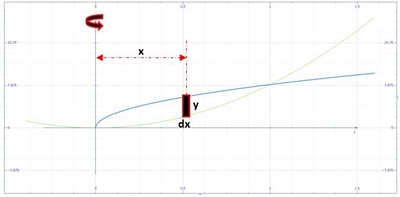 |
From the graph,
{eq}r=x,\:h=y,\:dr=dx {/eq}
Substituting to the formula {eq}V=2\pi \int_{a}^{b}rh\:dr {/eq}
Thus,...
See full answer below.
Ask a question
Our experts can answer your tough homework and study questions.
Ask a question Ask a questionSearch Answers
Learn more about this topic:

from
Chapter 14 / Lesson 5The volume of a revolution can be calculated using the slicing method, the disk method, and the washer method. Explore the processes of the three methods and discover how to use them to find the volumes of revolution.
Related to this Question
- Use the method of cylindrical shells to find the volume of the solid obtained by rotating the region bounded by x = sqrt(y), x = 0, and y = 2, about the x-axis.
- Use the method of cylindrical shells to find the volume of the solid obtained by rotating the region bounded by y = \sqrt{x - 4}, y = x-4 about the y - axis.
- Use the method of cylindrical shells to find the volume of the solid obtained by rotating the region bounded by y = 3+ 2x-x^2, x+y = 3 about the y-axis.
- Use the method of cylindrical shells to find the volume of the solid obtained by rotating the region bounded by x= \sqrt y, x=0 ,y =7 about the x-axis.
- Use the method of cylindrical shells to find the volume of the solid obtained by rotating about the y-axis the region bounded by y = 3 + 2x - x^2, x + y = 3.
- Use the method of cylindrical shells to find the volume of the solid obtained by rotating the region bounded by y = square root{x}, x = 0, and y = 2 about the x - axis
- Use the method of cylindrical shells to find the volume of the solid obtained by rotating the region bounded by the curves y = 4x^2 and 2x + y = 6 about the x-axis.
- Use the method of cylindrical shells to find the volume of the solid obtained by rotating the region bounded by the curves x = 16\sqrt y , x = 0, y=1 about the x-axis.
- Use the method of cylindrical shells to find the volume of the solid obtained by rotating the region bounded by curves y = x^2, and y = 6x - x^2 and the y-axis.
- Use the method of cylindrical shells to find the volume of the solid obtained by rotating the region bounded by the given curves about the x-axis. xy = 9, x = 0, y = 9, y = 11.
- Use the method of cylindrical shells to find the volume of the solid obtained by rotating the region bounded by the curves y=4x-x^2 and y=x about the y axis.
- Use the method of cylindrical shells to find the volume of the solid obtained by rotating the region bounded by the curves y = x^2 , \ y = 4x - x^2 and the x-axis.
- Use the method of cylindrical shells to find the volume of the solid obtained by rotating the region bounded by the given curves about the x-axis. xy = 3 x = 0 y = 3 y = 5
- Use the method of cylindrical shells to find the volume of the solid obtained by rotating the region bounded by the given curves about the x-axis. xy = 5, x = 0, y = 5, y = 7
- Use the method of cylindrical shells to find the volume of the solid obtained by rotating the region bounded by the curves x = 1 + (y - 7)^2, x = 17 about the x-axis.
- Use the method of cylindrical shells to find the volume of the solid obtained by rotating the region bounded by the given curves about the x-axis. x + y = 4, \quad x = {y^2} - 4y + 4
- Use the method of cylindrical shells to find the volume of the solid obtained by rotating the region bounded by the given curves about the x-axis. xy = 2, x = 0, y = 2, y = 4
- Use the method of cylindrical shells to find the volume of the solid obtained by rotating the region bound by x=28y^2 - 7y^3, x=0 about the x-axis.
- 1) Use the method of cylindrical shells to find the volume of the solid obtained by rotating the region bounded by the given curves about the x-axis. y = x^{3/2}, y = 8, x = 0 2) Use the method of cy
- 1. Use the method of cylindrical shells to find the volume of the solid obtained by rotating the region bounded by the given curves about the x-axis. x = 1 + (y - 5)^2, x = 17 2. Use the method of cy
- Use the method of cylindrical shells to find the volume of the solid obtained by rotating the region bounded by the given curves about the x-axis. y = \sqrt x, \enspace x = 0, \enspace y = 2
- Use the method of cylindrical shells to find the volume of the solid obtained by rotating the region bounded by the given curves about the x-axis. y=x^3, y=8, x=0
- Use the method of cylindrical shells to find the volume of the solid obtained by rotating the region bounded by the given curves about the x-axis. xy=1, x=0, y=1, y=3.
- Use the method of cylindrical shells to find the volume of the solid obtained by rotating the region bound by the curves xy = 9 , x=0,y=9, y=11 about the x-axis.
- Use the method of cylindrical shells to find the volume \displaystyle V of the solid obtained by rotating the region bounded by the given curves about the \displaystyle x-axis. \displaystyle x=4+(y-7)
- Use the cylindrical shell method to find the volume of the solid obtained by rotating the region bounded by the curves y = 4x - x^2 and y = x about the y-axis.
- Use the method of cylindrical shells to find the volume V of the solid obtained by rotating the region bounded by the given curves about the x-axis. x = 5 + (y - 5)^2, x = 14
- Use the method of cylindrical shells to find the volume V of the solid obtained by rotating the region bounded by the given curves about the x-axis. x = 1 + (y - 5)^2, x = 10
- Use the method of cylindrical shells to find the volume V of the solid obtained by rotating the region bounded by the given curves about the x-axis. y=x^3, y=2, x=0
- Use the method of cylindrical shells to find the volume V of the solid obtained by rotating the region bounded by the given curves about the x-axis. x = 4 + y^2, x = 0, y = 2, y = 3.
- Use the method of cylindrical shells to find the volume V of the solid obtained by rotating the region bounded by the given curves about the x-axis. x = 1 + (y - 5)^2, x = 10.
- Use the method of cylindrical shells to find the volume V of the solid obtained by rotating the region bounded by the given curves about the x-axis. x + y = 7, x = 16 - (y - 3)^2.
- Use the method of cylindrical shells to find the volume V of the solid obtained by rotating the region bounded by the curves x = 1 + (y- 6)^2, x=10 about the x-axis.
- Use the method of cylindrical shells to find the volume V of the solid obtained by rotating the region bounded by the given curves about the x-axis. x = 3 + (y - 6)^2, x = 19 V = ?
- Use the method of cylindrical shells to find the volume V of the solid obtained by rotating the region bounded by the given curves about the x-axis. Data: x = 5 + y^2, x = 0, y = 1, y = 2
- Use the method of cylindrical shells to find the volume V of the solid obtained by rotating the region bounded by the given curves about the x - axis. x + y = 7, x = 16 - (y - 3)^2 V =
- Use the method of cylindrical shells to find the volume V of the solid obtained by rotating the region bounded by the curves x = 4 + y^2 , \ x = 0 , \ y = 1 and y = 3 about the x-axis.
- Use the method of cylindrical shells to find the volume V of the solid obtained by rotating the region bounded by the given curves about the x-axis. x + y = 3, x = 4 - (y - 1)^2.
- Use the method of cylindrical shells to find the volume V of the solid obtained by rotating the region bounded by the given curves about the x-axis. x = 5 + y^2, x = 0, y = 2, y = 3
- Use the method of cylindrical shells to find the volume V of the solid obtained by rotating the region bounded by the given curves about the x-axis. x = 4 + y^{2} , \ \ \ \ x = 0 , \ \ \ \ y = 2, \ \
- Use the method of cylindrical shells to find the volume V of the solid obtained by rotating the region bounded by the curves x = 1 + (y - 7)^2, x = 17 about the x-axis.
- Use the method of cylindrical shells to find the volume V of the solid obtained by rotating the region bounded by the curves y = x^3, y = 8, and x = 0 about the x-axis.
- Use the method of cylindrical shells to find the volume V of the solid obtained by rotating the region bounded by the given curves about the x-axis. x + y = 1, x = 5 - (y - 2)^2.
- Use the method of cylindrical shells to find the volume V of the solid obtained by rotating the region bounded by the curves x = 4 + (y-7)^2, x = 12 about the x-axis.
- Use the method of cylindrical shells to find the volume V of the solid obtained by rotating the region bounded by the curves x+y = 4 and x=8-(y-2)^2 about the x-axis.
- Use the method of cylindrical shells to find the volume V of the solid obtained by rotating the region bounded by the given curves about the x- axis. x = 5 + y^2, x = 0, y = 1, y = 2.
- Use the method of cylindrical shells to find the volume of the solid obtained by rotating the region bounded by the given curves x = y^(1/2), x = 0, and y = 1 about the x-axis.
- Use the method of cylindrical shells to find the volume of the solid obtained by rotating the region bounded by the curves x = y^(1/2), x = 0, and y = 1 about the x-axis.
- Use the method of cylindrical shells to find the volume of the solid obtained by rotating the region bounded by the curves y = \ln x, x = 0, y = 0, and y = 1 about y = -1.
- Use the method of cylindrical shells to find the volume of the solid obtained by rotating the region bound by the curves y = x^2 \enspace and \enspace y = 8x-x^2 about the x-axis.
- Use the method of cylindrical shells to find the volume of the solid obtaining by rotating the region bounded by curves y = x^2 and y = 8x - x^2 and the x-axis.
- Let R be the region bounded by y = 4 - x^2 and the x-axis where 0 < x < 2. Use the method of cylindrical shells to find the volume of the solid obtained by rotating R about the y-axis.
- Use the method of cylindrical shells to find the volume V of the solid obtained by rotating the region bounded by the given curves about the x-axis. x = 2 + (y - 7)^2, x = 11
- 1.) Use the method of cylindrical shells to find the volume V of the solid obtained by rotating the region bounded by the given curves about the x-axis. y = x^3, y = 27, x = 0 2.) Set up the integral
- Use the method of cylindrical shells to find the volume v of the solid obtained by rotating the region bounded by the give curves x = 3 + y^2, x = 0, y = 1, y = 3.
- Find the volume using the cylindrical shell method of the solid obtained by rotating about the y-axis the region bounded by y = x, y = -x/2, and x = 2.
- Find the volume of the solid obtained by rotating the region bounded by y = 6 - x^2 and y = 2 about the x-axis, using both the Method of Disks/Washers and the Method of Cylindrical Shells.
- Use the method of cylindrical shells to find the volume V of the solid obtained by rotating the region bounded by the given curves about the x-axis. x = square root y, x = 0, y = 4.
- Use the method of cylindrical shells to find the solid obtained by rotating the region bounded by y = e^{-x^2}, x = 0, y = 0, x = 1 about the y-axis.
- Using the Method of Cylindrical Shells, the integral to find the volume of the solid obtained by revolving the region bounded by the curves y= 1 / x^2+1 and y = 0, x = 0, and x = 6 about the y-axis.
- Use the method of cylindrical shells to find the volume of the solid obtained by rotating the region bounded by the curves y=4x-x^2 and y=3 about the linex=1.
- Use the method of cylindrical shells to find the volume of the solid generated by rotating the region bounded by the given curves about the y-axis. y = 3x^2, y = 18x - 6x^2.
- Use the method of cylindrical shells to find the volume of the solid generated by rotating the region bounded by the given curves about the y-axis. y = 4x^2, y = 24x - 8x^2.
- Use the method of cylindrical shells to and the volume of the solid obtained by rotating the region bounded by the given curves about the x-axis. y=\sqrt{(x)}; x=0; y=2
- Use the method of cylindrical shells to find the volume of the solid obtained by rotating the region bounded by curves y= x^2 and y= 4x -x^2 and the x -axis.
- Use the method of cylindrical shells to find the volume of the solid obtained by rotating the region bounded by the curves y = x^2, y = 0, x = 2, and x = 1 about the y-axis.
- Use the method of cylindrical shells to find the volume generated by rotating the region bounded by x = y^2, \ x = 0, and y = 2 about the x-axis.
- Use the method of cylindrical shells to find the volume generated by rotating the region bounded by y = x^2, y = 0, and x = 1 about the y-axis.
- Use the method of cylindrical shells to find the volume generated by rotating the region bounded by y=4e^x, y=4e^(-x), and x=1, about the y-axis.
- Use the method of cylindrical shells to find the volume generated by rotating the region bounded by y = e^{-x^3}, y = 0, x = 0, and x = 1 about the y-axis.
- Use the method of cylindrical shells to find the volume generated by rotating the region bounded by yx^3,y=0 \ and \ x=1 about the axis: y=1.
- Use the method of cylindrical shells to find the volume generated by rotating the region bounded by y = 1 x , y = 0 , x = 1 , x = 2 about the y-axis.
- Use the method of cylindrical shells to find the volume V generated by rotating the region bounded by x = 2*sqrt(y), x = 0, y = 9 about the y-axis.
- Use the method of cylindrical shells to find the volume of the solid obtained by rotating the region bounded by the curves y = x^2, y = 0, x = 1, and x = 2 about the line x = 4. Volume =
- Find the volume of the solid obtained by rotating the region enclosed by y = e^{5x} + 4, y = 0, x = 0, y = 0.7 about the y-axis using the method of cylindrical shells.
- Use the method of cylindrical shells to find the volume V of the solid obtained by rotating the region bounded by the given curves about the x-axis. x=2+(y-6)^2, \ x=18
- Use the method of cylindrical shells to find the volume of the solid obtained by rotating the region bounded by y = \frac{1}{x}, y=0 , x=1 about the line y = -1
- Use the method of cylindrical shells to find the volume of the solid generated by rotating the region bounded by the curves about the given axis. y = e^x, x = 0, y = 3; about the x-axis.
- Use the method of cylindrical shells to compute the volume V of the solid obtained by rotating the region bounded by the given curves about the x-axis: x = 4 + y^2, x = 0, y = 1, y = 3.
- Use the method of cylinder shells to find the volume of the solid obtained by rotating the region bounded by the given curve about the x-axis. y=x^{2/3}, y=8, x=0.
- Use cylindrical shells to find the volume of the solid obtained by rotating the region bounded by y = x 2 , y = 0 , a n d x = 4 , about the y-axis.
- Use cylindrical shells to find the volume of the solid obtained by rotating the region bounded by y = x^2, y = 0, and x = 2, about the y-axis.
- Use cylindrical shells to find the volume of the solid obtained by rotating the region bounded by y= x^2, y= 0 and x= -3, about the axis x= -2.
- Use the method of cylindrical shells to find the volume of the solid obtained by rotating the region bounded by y = sqrt(x), x = 0, and y = 2 about the x-axis.
- Use the method of cylindrical shells to find the volume of the solid generated by rotating the region bounded by the curves y = e^x, x = 0, and y = pi about the x-axis.
- Use the method of cylindrical shells to find the volume of the solid generated by revolving the region bounded by y = \frac{7}{x}, y =0, x=2, x=7 about the y-axis.
- Use the method of cylindrical shells to find the volume of the solid generated by revolving the region bounded by y = (x-2)^2 and y = -(x-2)^2+3 about the y-axis.
- Find the volume of the solid obtained by rotating the region bounded by the given curves about the x-axis by using the method of cylindrical shells. xy = 9, x = 0, y = 9, y = 11
- Use the method of cylindrical shells to find the volume of the solid obtained by rotating the region bounded by the given curves about the x-axis. \displaystyle xy = 5, \space x = 0, \space y = 5, \space y = 7
- Use the method of cylindrical shells to find the volume generated by rotating the region bounded by y=4(e^x), y=4(e^-x), and x=1 about the y-axis.
- Find the volume of the solid obtained by rotating the region A about the x-axis. a. Using the washer method. b. Using the method of cylindrical shells.
- Use the method of cylindrical shells to find the volume of the solid obtained by rotating the region bounded by y = 8x - 2x^2 and y = 4x - x^2 about the line x = -2.
- Use the method of cylindrical shells to find the volume of the solid obtained by rotating the region bounded by , y = x , y = x 2 , and y = 0 about the line x = 2.
- Find the volume of the solid obtained by rotating the region bounded by y=6-x^2; \enspace and \enspace y=2 about the x-axis using the Method of Cylindrical Shells.
- Use the method of cylindrical shells to find the volume generated by rotating the region bounded by y =e^{-x^2}, y = 0, x = 0, x = 1 about the y-axis.
- Use the method of cylindrical shells to find the volume generated by rotating the region bounded by y = e^{-x^2}, y = 0, x = 0, and x = 1 about the y-axis.
- Use the method of cylindrical shells to find the volume generated by rotating the region bounded by the curves y=3+2x-x=xZ^2 and y+x=3 about the y-axis.
- Use the method of cylindrical shells to find the volume generated by rotating the region bounded by the given curves about the y-axis. y=x^(1/3), y=0, x=1
- Use the method of cylindrical shells to find the volume V generated by rotating the region bounded by the curves y=2e^x , y=2e^{-x} and x = 1 about the y-axis.
- Use the method of cylindrical shells to find the volume generated by rotating the region bounded by the curves y = \frac{1}{x}, y =0, x=2, x=4 about the y-axis.