
The simply supported beam of rectangular cross-section carries a distributed load of intensity...
Question:
The simply supported beam of rectangular cross-section carries a distributed load of intensity {eq}w_{o} {/eq} and a concentrated force P. Determine the largest allowable of P if the bending stress is not to exceed 10 MPa if: (a) {eq}w_{o}=3 kN/m; \ and\ (b) w_{o}=6 kN/m. {/eq}
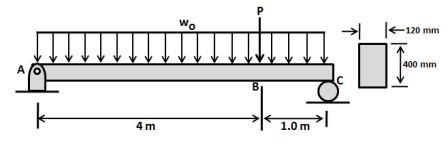 |
Bending Stress:
When a beam is supported on roller support at one end and hinged support at the other, then it is called as the simply supported beam. When we draw the shear force diagram and bending moment diagram, the bending moment will be maximum at the point where the shear force diagram changes sign (positive to negative or vice versa). The point where the bending moment diagram changes sign (positive to negative or vice versa) is known as the point of contraflexure.
Answer and Explanation: 1
Become a Study.com member to unlock this answer! Create your account
View this answer
We're given the following information in the problem:
- Maximum bending stress, {eq}\sigma_b = 10\ \rm{MPa} = 10^7 \rm{Pa} {/eq}
Bending moment of...
See full answer below.
Ask a question
Our experts can answer your tough homework and study questions.
Ask a question Ask a questionSearch Answers
Learn more about this topic:

from
Chapter 7 / Lesson 3Learn what statically determinate structures are. Discover factors of frame analysis, and study statical determinacy through examples and their equations.
Related to this Question
- A channel section is used as cantilever beam to support a uniformly distributed load of intensity w = 25 lb/ft and a concentrated load P = 50 lb. Determine the maximum tensile flexural stress and the
- For a beam have the cross-section shown, determine the largest allowable vertical shear if the shearing stress does not exceed 45 ''MPa''
- The beam has a rectangular cross section and is made of wood having an allowable shear stress of τallow = 200 psi. Determine the maximum shear force V that can be developed in the cross section of
- The beam has a rectangular cross-section. Determine the largest load P that can be supported on its overhanging ends so that the bending stress in the beam does not exceed sigma max=10 MPa . (Ans:
- A 5 ft. long cantilever beam is subjected to a uniform distributed load. The load intensity is given as 10 kip/ft. The cross section of the beam is shown below. Determine the maximum bending stress a
- The figure shows the cross section of a simply supported beam that carries a uniformly distributed loading of intensity 200 lbf/ft over its entire length L. If the allowable shear stress is =80 psi, determine the largest allowable value of L.
- A rectangular cross-section beam (width = b, height = h) supports a uniformly distributed load over its entire length (L). The allowable bending stress is ? allow and the allowable shear stress is
- The T-beam is made from two plates welded together as shown. Determine the maximum uniform distributed load w that can be safely supported on the beam if the allowable bending stress is 150 MPa, and the allowable shear stress is 70 MPa.
- If the concentrated force P= 2kN is applied at the free end of the overhanging beam determine the maximum shear stress at the cross-section at point B. (The centroidal neutral axis of the cross-section is located at 0.13068m from the bottom of the beam an
- The steel beam has a cross-sectional area shown. Determine the largest intensity of the distributed load W_{o} that it can support so that maximum bending stress in the beam does not exceed 22 ksi.
- For the hook of circular cross section shown in the figure below, (a) determine the maximum load P that may be supported without exceeding a stress of 101 MPa at point A. (b) Determine the stress at
- The attached figure shows a simply-supported beam of total length 8 m loaded by two concentrated forces of 10 kN each. The beam cross-section is 100 mm X 100 mm square. Find the magnitude and exact location of the maximum tensile stress due to bending. He
- There are two concentrated forces applied to cantilever beam of cross section as shown in the image. Determine the maximum tensile and compressive stresses in the portion BC of the beam.
- The hanger is supported using the rectangular pin. The allowable stress is (\sigma_t) _{allow} = 150 MPa, the allowable bearing stress is (\sigma_b) _{allow} = 290 MPa, and the allowable shear stress
- The post has a square cross-sectional area. If it is fixed supported at its base and horizontal force is applied at its end as shown, determine (a) the maximum in-plane shear stress developed at A and
- The overhang beam is subjected to the uniform distributed load having an intensity of w = 59 kN/m. Determine the maximum shear stress developed in the beam.
- The beam shown has a rectangular cross section 4 in wide and 8 in deep. Determine the maximum shear stress.
- For the beam shown, if the allowable bending stress is \sigma_{allow}=22 ksi and the allowable shear stress is \tau _{allow}= 12 \ ksi, select the lightest wide-flange section with the shortest depth that will safely support the load.
- The cross-section is rectangular with a base of 2 ''in'' and height of 8 ''in''. A force of P = 15 ''kip'' is acting on the beam. (a) Determine the absolute maximum bending stress in the beam , assuming that the support at ''B'' exerts a uniformly distrib
- A 5.0-'m''-long simply supported timber beam carries two concentrated loads as shown. the cross-sectional dimension of the beam is also shown. (a) A section ''a''-''a'', determine the magnitude of the shear stress in the beam at point ''H''. (b) A sectio
- The beam has a rectangular cross-section and is made of wood having allowable shear stress of tau allow = 200 psi. Determine the maximum shear force that can be developed in the cross-section of the b
- Two vertical forces are applied to a beam of cross section shown. Determine the maximum tensile and compressive stress in portion B C of the beam.
- A cantilever beam with cross-section is shown in Figure. The distributed load reaches its maximum intensity of 300 lb/in. Determine the bending normal stress at point A and the maximum bending normal stress in the section containing point A for the beam a
- Two vertical forces are applied to a beam of the cross section shown in the sketch. Determine the maximum tensile and compressive stresses in portion BC of the beam. ? t o p = ksi ? b o t = ksi (
- Determine the largest intensity w of the distributed load that the member can support if the allowable shear stress is tau_allow, = 1000 psi. The supports at A and B are smooth.
- Two vertical forces are applied to a beam. 1) Determine the maximum tensile and compressive stress in the beam. 2) Along the cross section B-B , determine the shearing stress at a and maximum shearing
- A simply supported beam ''AB'' with span length L = 6 m carries a uniform load of intensity q = 8.5 kN/m. The beam has a rectangular cross-section with width b =0.2 m and height h 0.35 m (a) Calculate the maximum tensile stress (MPa). (b) Calculate the
- Two vertical forces are applied to a beam of the cross section shown. Determine the maximum tensile and compressive stresses in portion BC of the beam.
- Two vertical forces are applied to a beam shown in figure of the cross-section shown. Determine the maximum tensile and compressive stresses in portion ''BC'' of the beam.
- The wood beam has an allowable shear stress of 7 MPa. Determine the maximum shear force V that can be applied to the cross section. It is a 4 rectangles that make one rectangle with the left and right
- Determine the allowable tensile load P for the prismatic bar shown. If the allowable tensile stress is sigma_allow = 135 MPa and the allowable shear stress is Tallow = 100 MPa. The cross-sectional dim
- The solid shaft is subjected to the distributed and concentrated torsional loadings shown, where T = 760 kN.m. The allowable shear stress for the material is \tau_{allow} = 54 MPa. Determine the requi
- The solid shaft is subjected to the distributed and concentrated torsional loadings shown, where T = 700 kN.m. The allowable shear stress for the material is \tau_{allow} = 52 MPa. Determine the requi
- A simply supported wood beam of length L= 6 ft carries a concentrated load P at midspan, as shown. The cross-sectional dimensions of the beam are b= 6 in. and h= 9 in. If the allowable shear strength
- The hanger is supported using the rectangular pin. Determine the required thickness t of the hanger, and dimensions a and h if the suspended load is P = 60 kN. The allowable tensile stress is (sigma_t)_allow = 150 MPa, the allowable bearing stress is (si
- The screw of the clamp exerts a compressive force of 500 lb on the woodblocks. Determine the maximum normal stress developed along section a-a. The cross-section there is rectangular. 0.75 in. by 0.50 in.
- The solid shaft is subjected to the distributed and concentrated torsional loadings shown, where T = 730 kN.m The allowable shear stress for the material is tau allow = 70 MPa . Determine the re
- Two vertical forces are applied to a beam of the cross section shown in figure. Determine the maximum tensile and compressive stresses in portion BC of the beam.
- Two vertical forces are applied to a beam of the cross section shown. Determine the maximum compressive and tensile normal stresses and the maximum transverse shear stress for the beam. Identify the l
- The solid shaft is subjected to the distributed and concentrated torsional loadings shown, where T=730 kN.m . The allowable shear stress for the material is tau_allow=70 MPa . Determine the requir
- Determine the maximum load P that can be applied to the beam if the bearing plates A' and B' have square cross sections of 2in x 2in and 4in x 4in, respectively, and the allowable bearing stress for t
- the bar has a 60 mm by 15 mm rectangular cross-section. The allowable normal and shear stresses on inclined surface a-a must be limited to 20 MPa and 10 MPa, respectively. Determine the magnitude of
- A 4-5 -''m'' long simply supported timber beam carries two concentrated loads as shown. The cress sectional dimensions of the beam are also shown. (a) At section a-a, determine the magnitude of the shear stress in the beam at point ''H''. (b) At section a
- 1) Two vertical forces are applied to a beam of the cross section shown above. Determine the maximum tensile and compressive stresses in portion BC of the beam. 2) Draw the free body diagram 3) Draw
- A T-beam is constructed as shown in the figure. What is the maximum shear force V that the beam can support if the allowable shear stress for the wood is tau_allow=6 MPa?
- The beam has the rectangular cross-section shown. If w = 3 kN/m, determine the maximum bending stress in the beam.
- The I-Beam shown is subjected to a bending moment of 635 kip-in. Determine the maximum tensile and compressive stresses in the beam. Also, calculate the resultant force of the bending stress distribution acting on the 6-inch wide x 0.50-inch thick top por
- The steel beam shown in the figure (Figure 1) has an allowable bending stress sigma_allow = 130 MPa and an allowable shear stress of tau_allow = 100 MPa. The beam has the cross section shown (Figure 2
- A beam is supported with a roller at B and a pin joint at A. A distributed load as shown below acts between A and B. The beam has a box cross sectional area. Determine a) The maximum shear stress in t
- The solid shaft is subjected to the distributed and concentrated torsional loadings shown, where T=860 kN.m . The allowable shear stress for the material is tau_allow=58 MPa . Part A Determine the
- Knowing that for the extruded beam shown in the figure, the allowable stress is 100 MPa in tension and 120 MPa in compression, determine the largest point load ''P'' that can be applied.
- The post has a square cross-sectional area. If it is fixed supported at its base and a horizontal force is applied at its end as shown, determine (a) The maximum in-plane share stress developed at A.
- A beam with a distributed load is shown in the figure below. If a concentrated force F=300 N is applied 0.2 m from support B, determine the magnitude of thereaction force (in N) at support B.
- A 74 in long simply supported steel beam is 2 in wide by 3 in tall. the cross section is shown below. use allowable bending stress of 1.264 ''kpsi'' for steel and find the maximum safe uniformly distributed load that the beam can carry, if the loading is
- A bar of solid square cross-section is loaded by a tensile axial force F as shown in the accompanying sketch. The depth and width of the bar is 14 mm. In this case, the magnitude of the applied force
- A simply supported wood beam of length L = 8 ''ft'' carries a concentrated load ''P'' at midspan, as shown. The cress sectional dimensions of the beam are b = 3in, and h = 4 in,.If the allowable shear strength of the wood is 185 ''psi'', determine the max
- A uniformly distributed force ''w'' = 800 lb/ft is applied to the inverted ''U'' shaped beam shown below. Determine the absolute maximum shear stress developed in this member. Also, calculate the perc
- Two vertical forces are applied to a simply supported beam with the cross-section shown. If L_{1}=1m, L_{2}= 3 m, and \ P= 10 kN, determine the maximum tension bending stress in the beam. The beam's moment of inertia about the z-axis is 10,577,574 mm^4, a
- A 4-in.-diameter, 12-ft-long solid steel shaft having a circular cross-section is used as a simply supported beam. A concentrated load P is to be applied at midspan. Calculate the maximum allowable lo
- A simply supported beam AB of the channel cross section carries a concentrated load P at midpoint . Find the maximum allowable load P based on an allowable normal stress of sigma_all = 60 M Pa in the
- Determine the larges permissible distributed load w for the beam shown, knowing that the allowable normal stress is +85 MPa in tension and -125 MPa in compression
- For a beam with a rectangular cross section (2 inches x 4 inches) subjected to a twisting load of 600 inlb, find the maximum shear stress.
- For the moment diagram and cross section shown, compute the maximum tension and compression bending stresses (in MPa) produced at any location along the beam span. The maximum stresses may occur at di
- Consider a simply supported beam made of a 2.5" x 2.5" A36 bar. The beam is 12 ft long and loaded in the middle with a 10 lb concentrated load. a. Using the general shear formula, determine the maximum shear stress in the bar and then state whether the b
- The cross-sectional dimensions of a beam are shown in the figure. (a) If the bending stress at point K is 35.0 MPa (T), determine the bending stress at point H. State whether the normal stress at H is a tension or compression. (b) If the allowable bending
- A simply supported wood beam of length l =12 ft carries a concentrated load ''P'' at midspan, as shown .The cross-sectional dimensions of the beam are b=4 in. and h=6 in. If the allowable shear streng
- The simply supported notched bar is subjected to the two loads, each having a magnitude of P = 100 lb. Determine the maximum bending stress developed in the bar, and sketch the bending stress distribu
- A cantilever beam (E=28 GPa and I= 5\times10^{-4}m^{4}) subjected to a uniformly distributed load and a concentrated load. Determine the maximum deflection of the beam.
- An extruded alumunum beam has the cross section draw below. Knowing that the vertical shear in beam is 170kN, determine the shearing stress, in Mpa at point a.
- If he beam is subjected to an internal moment of M = 5 kip-ft, determine the maximum tensile and compressive stress in the beam. Also, sketch the bending stress distribution on the cross section.
- For the stepped shaft shown in the figure below, determine a solid circular cross-section for each section shown such that the bending stress does not exceed 160 MPa and maximum deflection does not exceed L/360 of the span.
- A simply supported beam is loaded by a fluctuating force F = 600 \sim 1400 kN. The cross-section is a rectangular area. Find factors of safety using Gerber and Langer criteria. The material property of the beam: S_{ut}=500 MPa,S_{y}=400 MPa, S_{u}=100 MPa
- The cross section is rectangular with a base of 3 in and height of 5 in. A force of P=16 kip is acting on the beam. Determine the absolute maximum bending stress in the beam, assuming that the suppor
- The material of the beam has a yield strength in shear of 379 MPa. What is the max allowable shear in the rectangular beam?
- A rectangular cross section, cantilever beam is made of 18Cr9Ni stainless steel (e = 200 Gpa, S_a=727 MPa). It has been determinate that the load cycles will never exceed 10^5. Determine the magnitude
- A simply supported beam with spans of a=1.5 m and b=5.5 m supports loads of w=40 kN/m and P=30 kN, as shown. At the section of maximum shear force, determine the horizontal shear stress at a distance
- The simple supported notched bar shown is subjected to two loads each having magnitude of P = 100 lb. Determine the maximum bending stress developed in the bar, and sketch the bending stress distribut
- A W150\times 14 wide flange beam is loaded and supported as shown in the figure. Determine (a) The maximum tensile and compressive bending stresses in the beam; (b) The maximum shear stress in the flange and the maximum shear stress on the web.
- A simply supported wooden beam must carry a concentrated (downward) load P = 700 lb applied at the center of its span. The distance between the supports (i.e. the span) is 12 ft. Determine the maximum bending stress in the beam.
- The frame is loaded by a uniform distributed force q as shown. Consider only the stresses in bars AC and BC; each has a cross-section that is 0.75 in by 1.5 in. Determine the maximum allowable distrib
- For the beam and loading shown, consider section n-n and determine: a) the largest shearing stress int he section, b) the shearing stress at point a.
- The allowable bending stress is 30 ksi and the allowable shear stress is 15 ksi. (a) Draw the shear and moment diagrams for the W14x22 wide-flange beam. (b) Will the beam safely support the loading?
- The 12m long beam shown bellow supports a 2.7 kN load at a = 7m. Determine the maximum shear stress in the beam. T section dimensions b = 180 mm, d = 60 mm, t_f = 20 mm, t_w = 18 mm.
- A cantilever wood beam with a span of L = 3.7 m supports a linearly distributed load with the maximum intensity of w_0. The beamwidth is b = 140 mm, and the beam height is h = 120 mm. The allowable bending stress of the wood is 8.5 MPa. Calculate the magn
- Two vertical forces are applied to a beam of the cross section shown. Determine the maximum tensile and compressive stress in portion BC of the beam.
- Two vertical forces are applied to a beam shown in the figure. (a) Determine the maximum tensile and compressive stresses in portion BC of the beam; (b) Draw the free body diagram; (c) Draw the shear
- The beam is made of a material for which the allowable stress is 24 MPa in tension and 30 MPa in compression. Determine the largest couple M that can be applied to the beam.
- The internal shear force at a certain section of a steel beam is V = 132 kips. If the beam has the cross-section shown, determine the maximum horizontal shear stress in the flanged shape. The centroid is 5.283 in. above the bottom surface of the beam, and
- The distributed load acts on the beam as shown. Determine the maximum intensity w max . What is the magnitude of the equivalent resultant force. Specify where is acts measured from A.
- A beam with the cross-section shown is subjected to a vertical shear of 22 kips. Determine: (a) the largest shearing stress in that section, (b) the shearing stress at Point a a.
- A wide flange W 200 \times 71 structural steel column of effective length L_e = 5 m is to support an eccentric load P as shown. Assume E = 200 GPa, allowable \sigma_y = 250 MPa and (\sigma_{all})_{ben
- For the beam shown in the figure: a) Draw the shear force and bending moment diagrams. b) If the beam has a cross section of 1.5" x 2.5" (b x h), what us the maximum tensile stress corresponding to th
- Determine the largest permissible distributed load w for the beam shown, knowing that the allowable normal stress is +70 Mpa in tension and -135 MPa in compression.
- The two bar steel truss, pin-supported at A and C, pin connected at B. The allowable design stresses are: tension (125 MPa), shear (45 MPa). Determine: a) The required size of the cross section area o
- There is a beam having the cross section shown , subjected to a vertical shear V. Determine (a) The horizontal line along which the shearing stress is maximum (b) The constant k in the following expression for the maximum shearing stress where A is th
- The couple M is applied to a beam of the cross section shown in a plane forming an angle ? with the vertical , Determine , (a) The maximum tensile stress, (b) The maximum compressive stress, and (
- The allowable bending stress is sigma_allow = 24.9 ksi and the allowable shear stress is tau_allow = 15 ksi. Determine the minimum width of the beam that will safely support the loading of P = 8 kip.
- The simply supported beam is made of timber that has an allowable bending stress of sigma_allow=6.5 MPa and an allowable shear stress of tau_allow=500 kPa. Determine its height and width if it is to b
- The boards are bolted together to form the built-up beam. Each bolt has a shear strength of 5 kip. If the beam is subjected to a shear force of V = 16 kip , determine the allowable maximum spacing of
- The steel bar has the dimensions shown. Determine the maximum axial force P that can be applied so as not to exceed an allowable tensile stress of ? a l l o w = 150 M P a.