
In the given figure {eq}q_2 {/eq} has no net charges,determine {eq}q_1 {/eq}.
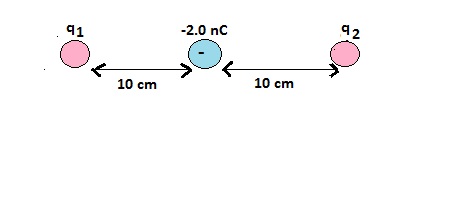 |
Question:
In the given figure {eq}q_2 {/eq} has no net charges,determine {eq}q_1 {/eq}.
|
Conservation of Charge and Electrostatic Induction:
A charge can never be created nor it can be destroyed. The total amount of charge present in the system is conserved.
When we bring a positive charge near an uncharged object, then negative charges on the uncharged gets concentrated on the near side of the positive charge while the far end has more concentration of positive charges. The uncharged object still remains electrically neutral, as no charge is created.
Answer and Explanation: 1
Become a Study.com member to unlock this answer! Create your account
View this answerIn the given diagram we see that there is no charge on {eq}q_2 {/eq}.
This is only possible when the other two particles have equal and opposite...
See full answer below.
Ask a question
Our experts can answer your tough homework and study questions.
Ask a question Ask a questionSearch Answers
Learn more about this topic:

from
Chapter 28 / Lesson 46Learn if electrons are negatively charged particles. See the negative charge definition and the difference between positively and negatively charged particles.
Related to this Question
- Three charges are arranged as in the figure. What is the electric potential at a point midway between charges q2 and q3?
- In the figure, calculate the total electric field due to both charges Q1 and Q2 at point A.
- In the figure, calculate the total electric field due to both charges Q1 and Q2 at point B.
- Two charges, Q1 +1.00 x 10⁻⁹C; Q2,= -1.00 x 10⁻⁹C are positioned as follows: Q1 (0.00 m, 2.00 m) and Q2 (2.00 m, 0.00 m) Determine the following at the point (1.00 m, 0.00 m): a. The distan
- Charges q1 and q2 lie on x axis at points x = -a and x = 5 , respectively. (a) how must q1 and q2 be related for the net force on charge +Q at x = a/2 to be zero ? (b) and if +Q is placed at x = 3a/2 .
- Three-point charges are positioned as follows: q1 is at (0 m, 0 m), q2 is at (1.2 m, 0 m), and q3 is at (1.2 m, 1.6 m). If q1 = 1.00 C, q2 = 2.00 C, and q3 = 3.00 C, what is the magnitude of the force on q2?
- Three charges are arranged, as shown in the figure below. Find the force on the charge q2 assuming that q1 = 6.0 x 10 minus 6 C, q2 = minus q1, q3 = +3 x 10 minus 6 C, and a = 2.0 x 10 minus 2 m. (Theta = 45 degrees).
- Two point charges are separated by 25.0 cm(see (Figure 1) ). Assume that q1 = -6.00 nC and q2= -14.5 nC . A. Find the net electric field these charges produce at point A. Express your answer in newto
- The figure shows three charges q1, q2 and q3 having a charge of -8.00nC each They are seperated as shown below. a. What is the electric force on q2 in terms of i, and j? b. What is the electric field
- Consider the four charges in the diagram below, in which q2 = +5 nC. The net force on the 1 nC charge is zero. How much is q1?
- The two charges in the figure below are separated by d = 3 cm. (Let q_{1} = -17.5 nC and q_{2} = 26.5 nC].) (a) Find the electric potential at point A. (b) Find the electric potential at point B, which is halfway between the charges.
- Three-point charges are arranged as shown. Find the magnitude and direction of the electric force on charge q_{1} = +5.26 nC if q_{2} = +6.00 nC, q_{3} = -3.00 nC, r_{12} = 0.235 m, and r_{13} = 0.10 m.
- Charge q2 in the figure below is in static equilibrium. Assume that q = 5.2 nC . What is q1?
- Charges q_1 and q_2 lie on the x-axis at points x equal to -a and +a respectively. How should q_1 and q_2 be related for the net force on charge +Q placed at x equal to fraction{+a}{2} to be zero?
- Charges q_1 and q_2 stay on the x axis at x = -a and x = +a. How must q_1 and q_2 be related for the net force on a third charge +Q, placed at x = +a/2, to be zero?
- Consider two charges Q_{1} = +6.50 nC and Q_{2} = -3.50 nC in the following diagram. Find the potential at point a.
- Charges q_1 and q_2 are located as shown in the figure. Determine the magnitude of the electric field at point A.
- Suppose the charge q2 in the figure(Figure 1) can be moved left or right along the line connecting the charges q1 and q3. Given that q=+12?C, find the distance from q1 where q2 experiences a net elect
- The figure shows three electric charges labeled Q_{1}, Q_{2}, and Q_{3}. Q_{1} and Q_{2} are both positive and Q_{3} is negative. They all have the same magnitude of charge. Draw the resulting equipot
- Determine the distance between charge Q1 of 20 muC and Q2 of 100 nC if the force between the two charges is 9.6 x 10³ N.
- A charge q1 = 7.00 \times 10^{-6} C is placed 0.300 m from a second charge q_2 = -5 \times 10^{-6} C. a) Find the magnitude of the force between the two charges.
- Three charges, Q1=10C, Q2=8C, and Q3=7C, are lying along a straight line. Q1 is one meter away from Q2, and Q2 is one meter away from Q3. Find the net electric force on Q1.
- The figure shows the electric field lines near two charges q1 and q2. What is the ratio of their magnitudes?
- Three point charges q_1,\; q_2, and q_3 are along the x-axis. The net force on the charge q_2 is \vec{F}_2 = +2.800\hat{i} N, when x_2 = 34.0 cm and x_3 = 64.0 cm. If q_1 = 5.0 \; \mu C and q_3 = 8.0 \; \mu C, find q_2.
- Three charges are placed in a line, as shown in the figure. a. Determine the magnitude and direction of the net force on q2. b. Use your answer to part (a) to calculate the magnitude of the electric field at point P from charges q1 and q3.
- Two point charges q1=+2.45nC and q2=-6.80nC are 0.100 m apart. Point A is midway between them; point B is 8.00 x 10^-2 from q1 and 6.00 x 10^-2 from q2. (See the figure below(Figure 1) .) Take the e
- Calculate the total electric field due to charges Q1 and Q2 (a) at point A and (b) at point B shown in the figure.
- Three charges are located along a straight line as shown below. What is the net electric force on charge q1?
- Two charges, q1 = minus 17 nC and q2 = 26.5 nC, are separated by a distance d = 2.50 cm, as shown in the figure. Determine the electric potential (in kV) at point B, which is halfway between the charges.
- Charges q1 and q2 lie on the x axis at points -2.900nm and 9.200nm respectively. What is the ratio of q1 to q2 for the net electrostatic force on charge q3 placed 7.204nm on the x axis to be zero. Rep
- Three identical charges (-3.0 \mu C }] each ) Q_{1} , Q_{2} and Q_{3} are each located at 2.0m from the origin respectively. (a) Find the magnitude and direction of the electric force on Q_{1} by Q_
- For the three point charges in the figure below: a. Determine the electric potential at point P. Assume V = 0 at infinity. Express your answer in terms of q_1, q_2, q_3, d_1, d_2, d_3. b. How much ele
- The figure shows three charges q_1, q_2, q_3 having a charge of -40.00 nC each. a. What is the electric force on q_2? Write in unit vector notation. b. What is electric field at q_2? Write in unit ve
- A point charge q1 = -4.00 nC is at the point x = 0.60 m, y = 0.80 m , and a second point charge q2 = +6.00 nC is at the point x = 0.60 m , y = 0. A.) Calculate the magnitude of the net electric field
- 4. Find the magnitude of the force between two charges Q1 = 3 C, Q2 = 2.5 C that are 50mm apart.
- (A) What is the magnitude of the net electric force on charge A in the figure? Assume that q_1 = 0.70 nC and q_2 = 4.0 nC. (B) What is the direction of the net electric force on charge A?
- Three charges are arranged, as shown in the figure below. If q2 = 0 C, what is the electric field at the position of q2 due to the other two charges?
- The charge in the middle of the figure is Q = -3.8 nC. Charge q2 will be in static equilibrium for what charge q1?
- Two charge q_1 (-3, 2) and q_2 (2, -1) are placed on a graph. Assume that both charges are positive. What is the magnitude of the total electric field at point P in terms of q_1 and q_2?
- Find the force acting on the charge q2. Given the electric charge configuration below q1 = -1.602x10^-9 C, q2 = 2.02 x 10^-9 C, q3 = - 3.0 x 10^-9 C
- A point charge q1 = -4.00 nC is at the point x = 0.60 mm, y = 0.80 mm, and a second point charge q2 = +6.00 nC is at the point x = 0.60 mm, y = 0. A) Calculate the magnitude of the net electric field at the origin due to these two point charges. B) Calcu
- Magnitude of two given charges is q_1 = -2Q \ and \ q_2 = +Q. The surface S_4 encloses both charges, S_2 encloses q_1, S_1 encloses q_2 and S_3 does not enclose any of the two charges. Give the electr
- Two point charges, q1 = 2 \muC and q2 = - 4 \muC, are fixed at points P1 and P2 respectively, as shown in the figure. a) Find the potential difference between points b and a (Vb - Va). b) How much w
- Three charges are placed as shown. The value of q1 is 1.7 \mu C and the value of q3 is -3.0 \mu C. The net force on q3 is in the negative x-direction. 1) Determine the charge on q2. 2) Determine the magnitude of the net force on q3.
- In the figure below, q3 = -13 nC, and charge q2 is in static equilibrium. What is q1? Hint: You can assume a value for the charge of q2 if you like, but it turns out that the value doesn't matter. What does it mean for q2 to be "in equilibrium"?
- What can you say about two charges q1 and q2 , if the electric field one-fourth of the way from q1 to q2 is zero?
- Three point charges are Q1 = +3.00 mu C, Q2 = +5.00 mu C, and Q3 = minus 6.00 mu C. Find the direction and magnitude of the electrical force acting on the Q2 charge.
- A charge q1 = 2.42 mu C is at a distance d = 1.43 m from a second charge q2 = -5.07 mu C. Find the electric potential at point A between the two charges that is d/2 from q1.
- In the figure, the particles have charges q1 = -q2 = 470 nC and q3 = -q4 = 90 nC, and distance a = 4.7 cm. What are the (a) x and (b) y components of the net electrostatic force on particle 3?
- Two charges, q1 = minus 17 nC and q2 = 26.5 nC, are separated by a distance d = 2.50 cm, as shown in the figure. Determine the electric potential (in kV) at point A.
- Three charges lie along the x axis as shown: q1 = 6 mu C, q2 = minus 2 mu C. Determine the magnitude and direction of the net force on q3 = 1.5 mu C.
- 1. There are three charges fixed on xy plane. They are q1 = 1mC at (0,0) , q2 = -2mC at (17 mm,-5 mm), and q3 = -3mC at (-2 mm, 11 mm) a) What is the force on q2 b) If q1 is removed, what is the net
- In the figure below, four particles have charges q1 = -q2 = 530 nC and q3 = -q4 = 97 nC, and distance a = 4.3 cm. What are the (a) x and (b) y components of the net electrostatic force on particle 3?
- For, q_1 = +q, q_2 = -2q, q_3 = +3q and d_1 = d_2, find the direction and magnitude of the net electrostatic force exerted on the point charge q_1 in the figure. Given that q = 11 \space \mu C and d =
- A point charge q1 = -4.00 nC is at the point x = 0.60 m, y = 0.80 m , and a second point charge q2 = +6.00 nC is at the point x = 0.60 m, y = 0. Calculate the magnitude of the net electric field at the origin due to these two point charges. Calculate the
- A point charge with q1 = +1.7 C is located at x = -3.0 m, y = 0, and a second point charge with q2 = +3.6 C is at x = +1.0 m, y = +2.0 m. (a) What is the force exerted by q1 on q2? (b) What is the for
- Two charges q1 = 2e and q2 = - 4e are placed on the x-axis at points (0; 0) and (a; 0) respectively. (a) What is the magnitude and direction of the electrostatic force on q2 due to q1 ? (b) Suppose a third charge q3 = -e is introduced at th
- Suppose the charge q_2 in the figure below can be moved left or right along the line connecting the charges q_1 and q_3. Given that q = +15 \mu C, find the distance from q_1 where q_2 experiences a net electrostatic force of zero? (The charges q_1 and q_
- Two point charges Q_1 and Q_2 (such that Q_1 = 4Q_2) are separated by a distance d. At a distance x from Q_1 going towards Q_2, the magnitude of the electric field is zero. Calculate the ratio x/d.
- q2 = -4.0 x 10^{-6}C; q1 = +2.9 x 10^{-6}C; q3 = -6.9 x 10^{-6} C. From q2 to q1, the distance is 0.20 m, and from q1 to q3 the distance is 0.14 m. Draw a free body diagram of the electrostatic forces acting on q1 by the other two point charges. Determine
- Consider three single charges at the corners of a square as shown below. Assume q_1 = q_2 = 2q_3. a. Find the net force on q_3 due to q_1 and q_2. b. Find the strength of the electric field at P. c. F
- Two point charges Q1 and Q2 are 4C. They are 10cm apart. At what distance betwen the charges the net electric field will be zero?
- In the figure, charge q_2 is in static equilibrium. What is q_1?
- Three charges q1, q2, and q3 are arranged, as shown below. Determine whether the statement below is true/false. If q1 is positive, q2 is positive, and q3 is positive, then q2 must experience the net force to the left.
- You are given two unknown point charges, Q1 and Q2. At a point on the line joining them, one-third of the way from Q1 to Q2, the electric field is zero. Are Q1 and Q2 like or unlike charges? How many
- Three charges q1, q2, and q3 are arranged, as shown below. Determine whether the statement below is true/false. If q1 is negative, q2 is positive, and q3 is positive, then q2 must experience the net force to the left.
- Four charges are located at the corners of a square, as shown in the figure. Find the magnitude and the direction of the net force on the charge q2.
- Find the direction and magnitude of the net force exerted on the point charge q_1. Give your answer in terms of q and d.
- Three point charges are arranged along the x-axis. Charge q1 = -4.50 nC is located at x = 0.200 m, and charge q2 = +2.50 nC is at x = -0.300 m. A positive point charge q3 is located at the origin. (a) What must the value of q3 be for the net force on this
- In the figure below, the particles have charges q_1 = -q_2 = 255 nC and q_3 = -q_4 = 168 nC, and distance a = 3.6 cm.
- Consider three single charges at the corners of a square as shown below. Assume q1=q2=2q3. Find the net force on q3 due to q 1 and q2. Find the strength of the electric field at P (4th corner of squ
- A particle of charge q1 = 3 x 10^(-6) C is 4 m distant from a second particle of charge q2 = -3 x 10^(-6) C. Calculate the magnitude of the magnitude of the net Electric Field midway between the two p
- A charge Q1 = 4.95 x 10^-7 C is located at the origin and a charge Q2 = 5.92 x 10^-7C is located at (0, 3.00) m, as shown in the figure. Find the total electric potential in units of V due to these charges at the point P, whose coordinates are (4.00, 0) m
- Three identical charges (q1, q2 and q3) are at the corners of an equilateral triangle of side length 1.00 mm. 1. Sketch a representative diagram. 2. Indicate the direction of the net force on each of the three charges.
- Two charges, Q1 and Q2, are separated by distances. (a) Calculate the magnitude of the electric field at point P. Point P is between both charges and has a distance of d1 from Q1 and d2 from Q2. Q1 = 1.90 muC, Q2 = 1.40 muC, d1 = 1.40 m, d2 = 1.90 m (b) C
- In the below figure, the three particles are fixed in place and have charges q1 = q2 = +2e and q3 = +1e. The distance a = 6.19 micro m. What is the magnitude of the net electric field at point P due to the particles?
- Three charges q1, q2, and q3 are arranged, as shown below. Determine whether the statement given below is true/false. If q1 is positive, q2 is negative, and q3 is negative, then q1 must experience the net force to the right.
- Two point charges of unknown magnitudes q1 and q2 are in a line. The electric field intensity is zero at point P, which is closer to q1 than q2. What can be said about the signs of their charges and t
- A point charge q_1 = -4.00 nC is at the point x = 0.600 m, y = 0.800 m, and a second point charge q_2 = 8.00 nC is at the point x = 0.600 m, y = 0. Calculate the magnitude and direction of the net ele
- Two charges q1 = -5 mu*C and q2 = 3 mu*C are separated by a distance of 9 cm. Find the magnitude of the electric field at a point midway between the charges.
- You are given two unknown point charges, Q1 and Q2. At a point on the line joining them, one-third of the way from Q1 to Q2 the electric field is zero. What is the ratio Q1/Q2?
- Two point charges Q1 and Q2 of equal magnitudes and opposite signs are positioned as shown in the figure. Which of the arrows best represents the net electric field at point P due to these two charges? (a) A (b) B (c) C (d) D
- Consider two charges Q1 = +7.00 nC and Q2 = -1.10 nC in the diagram below. Find the potential at point a.
- Suppose charge Q is midway between two positive charges, q1 and q2. If Q=-7.5nC, what must be the charge on q1 so that charge q2 remains stationary as Q and q1 are held in place? You must include a force diagram as part of your answer.
- Three charges are arranged as shown in figure .find the force on the charge q3 assuming that q1 = 6 uC ,q2=-6 uC ,q3=3 u.C and a=2cm
- Three-point charges are arranged on a line. Charge q3 = +5.00 nC and is at the origin, charge q2 = -3.50 nC and is at x2 = 3.50 cm and charge q1 is at x1 = 1.00 cm. What is q1 (magnitude and sign) if the net force on q3 is zero?
- Two point charges q_1 = +2.00 nC and q_2 = -6.00 nC are 0.100 m apart. Point A is midway between them and point B is 0.080 m from q_1 and 0.060 m from q_2. Take the electric potential to be zero at in
- Three point charges are on the x axis, q1 is at the origin, q2 is at x = 4.00 m, and q3 is at x = 8.00 m. (a) Find the potential at the point x = 0, y = 4.00 m if q1 = q2 =q3 = 6.45 muC. (b) Find the potential if q1 = q2 = 6.45 muC and q3 = -6.45 muC.
- Three point charges lie along a straight line, where q_1 = 6.3 \ \muC , q _2 = 1.47 \ \muC , and q _3 = -2.1 \ \muC. The separation distances are d_1 = 3.00 \ cm and d_2 = 2.00 cm. Calculate the magnitude of the net electric force on charge q_2 .
- Two point charges q1=+2.50nC and q2=?6.40nC are 0.100 m apart. Point A is midway between them; point B is 0.080 m from q1 and 0.060 m from q2. (See (Figure 1) .) Take the electric potential to be zero
- Three charges are placed on the x- axis as follows: q1 = 2 micro C at x = 0, q2 =-6 micro C at x = 0.75m, q3 = 4 micro C at x = 1.5 m. Calculate the net force on q2.
- Three charges are arranged as shown in the figure below. find the magnitude and direction of the electrostatic force on the charge q = 5.04 nC.
- Consider the following figure, four particles form a square. The charges are q1 = +Q, q2 = q3 = q, and q4 = -31.0Q. What is q/Q if the net electrostatic force on particle 1 is zero?1 is zero?
- Charge q1 =10 nC is at the origin,charge q2 = 16 nC is on the x axis at x = 4 m, and charge q3 = 20 nC is at a point x = 4 m and y = 4 m. Find the magnitude and direction of the resultant force on q2.
- Three-point charges are on the x-axis, q1 is at the origin, q2 is at x = 4.00 m, and q3 is at x = 8.00 m. (a) Find the potential at the point x = 0, y = 4.00 m if q1 = q2 =q3 = 7.65 \mu C. _______ kV (b) Find the potential if q1 = q2 = 7.65 \muC and q3
- A charge q1 = 2.32 {\mu}C is at a distance d = 1.73 m from a second charge q2 = -5.27 {\mu}C. (a) Find the electric potential at a point A between the two charges that is d/3 from q1. (b) Find a point
- What is the electric field magnitude midway between charges of Q1 = 4 C and Q2 = 7 C separated by 2 m?
- A point charge q1 = 5.0 muC is at the origin and a point charge q2 = 6.0 muC is on the x-axis at x = 3 m. a. Find the electric force on charge q2. b. Find the electric force on q1. c. How would your answers for parts (a) and (b) differ if q2 were -6.0 muC
- Three point charges q1, q2 and q3 are placed along a straight vertical line to create a 'tripole'. At point P, which is directly to the right of q1, the net electric field is exactly zero. We also kn