
Absorbance A570 of an unknown BPB solution was found to be 0.445. Calculate the concentration in...
Question:
Absorbance A570 of an unknown BPB solution was found to be 0.445. Calculate the concentration in mg/mL of the unknown BPB (MW = 670) solution using the standard calibration curve below.
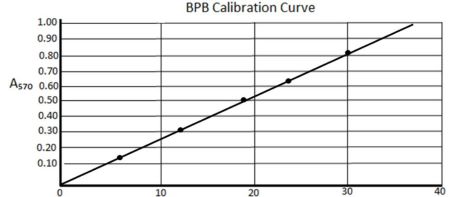 |
Standard curve
In laboratory, standard curves are prepared in almost all experiments to calculate the concentration of compound/substance of unknown samples. Standard curve is also called the calibration curve. Basically pure compound solutions are prepared with known concentrations. The O.D. value of each solution is noted and a graph of O.D. vs concentration is prepared. If the points form a straight line, one can use a straight-line equation to find out the concentration of unknown samples by simply measuring their O.D.
Straight line equation is,
Y = mX + C
where Y= value at Y-axis, m=slope of straight line, C=intercept at Y-axis. X = value at X-axis.
If a straight line passes from 0,0 point, C becomes zero. Thus, X=(Y/m).
Answer and Explanation: 1
Become a Study.com member to unlock this answer! Create your account
View this answerConcentration of BPB sample can be calculated as follows:
The standard graph can be used first to find the slope of a straight line (refer to the...
See full answer below.
Ask a question
Our experts can answer your tough homework and study questions.
Ask a question Ask a questionSearch Answers
Learn more about this topic:

from
Chapter 9 / Lesson 18Learn how to write slope in standard form and slope-intercept form. Also find the slope of a line and how to find the slope of a linear equation with examples.
Related to this Question
- If you place a cuvette with an unknown concentration of a solute in the spectrophotometer and it reads an absorbance of 0.15 AU, estimate the concentration of the solute inside.
- How do you find the concentration of FeSCN 2+, if you are only given the absorbance?
- You are conducting an experiment using a spectrophotometer and are measuring two blue solutions at the appropriate wavelength and comparing their absorption values. For solution one, you obtain an absorbance of zero point two one and for solution two, yo
- You need to determine the molarity of a stock solution of substance Y. You took 1mL from the stock of solution Y, added it to 49mL of water. The new diluted solution Y has a measured value of 10% Transmittance. Substance Y has a molar extinction coefficie
- What would you expect if sterile dH2O was used as a blank when determining the absorbance of... 1 answer below What would you expect if sterile dH2O was used as a blank when determining the absorban
- The concentration of a solute is 5 mM (molecular weight is 300 g/mol) and a cuvett (pass length,1.2 cm) is used to obtain an absorbance of 0.5 at 340 nm. Please calculate the molar extinction coeffici
- Convert the given extinction coefficent 6.39 mM^{-1} * cm^{-1} to M^{-1} , then solve for the theoretical absorbance. L = 1 cm c = 0.1
- The absorbance of a cationic iron(II) sample solution was measured in a spectrophotometer, but instrument returned an error because the absorbance was too high. The sample was then diluted by using a
- The absorbance of a protein solution measured in a 1.0 cm cuvette at 278 nm was 1.145. The protein content of that solution, calculated from quantitative amino acid analysis, was 256 micrograms/mL. Ca
- When plotting the standard curve of a substance on graph paper, what is the expected relationship between the concentration of the chemical and the absorbance reading?
- Studenrs placed the blank into the spectrophotometer. If they saw the absorbance increase rapidly and consistently over time with just the blank, what would that suggest? Would having a reaction occur with just the blank pose a problem or not?
- You ask your lab assistant to prepare 1L of solution Zeta at a concentration of 1 M. He comes up to you with a 0.5 M stock solution and asks for help in calculating how much to use. What do you tell him?
- The standard curve is made using BSA instead of milk because (a) Using BSA makes it easy to add a specific, known concentration of protein to each standard. (b) The spectrophotometer needs to be blanked using BSA. (c) BSA reacts with Bradford reagent b
- You have a green solution and you are trying to read the absorbance. However, when you use the spectrophotometer at 680 mm, you get a reading of HIGH. You address this problem by diluting your samples
- If we can use spectrophotometer reading to calculate the CFU/ml for the growth curve, why didn't we use the spectrophotometer for the DRT curve?
- You have an 8X stock of a sample. You need 40 total microliters of a sample at 1X concentration to be run on a gel. How do you prepare this solution?
- Seventy microliters of a 1:100 dilution of a sample were added to 3 ml of Bradford reagent. The absorbance at 595 nm was 0.371, which corresponds to 18.0 ?g protein according to a standard curve. What is the protein concentration of the original stock sol
- A solution of Na2CO3 contains 53g of solute in 200ml of solution. What is the molarity of this solution?
- A spec set at 286 nm is a good at detecting iodine and starch. A group of students tested a series of starch solutions with iodine, then measured their absorbance. These students had a sample of cornstarch in water and at an unknown concentration. 1. Exp
- Design an Experiment: If you are given a solution of sucrose that has an unknown molarity (.2, .4, .6, .8, 1.0), how could you use dialysis tubing bag, distilled water, etc to determine the molarity of your unknown solution?
- The solubility of a compound, with a molecular weight of 240.6, is determined to be 28.6g in 150.0g of water, at 398K. Express this concentration, in terms of molality. Express the concentration of th
- You measure the absorbance at 260 nm of your purified DNA samples diluted 20x in a 1 cm cuvette and you get a reading of 0.2. What is the concentration of your sample?
- In regards to spectrophotometry, what is an absorbance spectrum used for? What are the x and y axes for an absorbance spectrum?
- What is the percent concentration of a 300 mM solution of CaCl_2?
- To find the equilibrium constant: a. one should take the log10 of the concentration of products over the concentration of reactants b. none of the answers is correct c. one should measure the concentr
- A water sample contains the pollutant chlorobenzene with a concentration of 15 ppb. What is the molarity of this solution? Assume the density of the solution is 1.00 g/mL. The molar mass of chlorobenz
- In the laboratory, you dissolve 13.2 g of sodium bromide in a volumetric flask and add water to a total volume of 125 mL. a. What is the molarity of the solution? b. What is the concentration of the
- - You want 100 microliters of a 200 CFU/microliter solution. You run a standard plate count on your bacterial stock and calculate your concentration to be 500 CFU/microliter. How much of your stock solution do you need? - You want to grow an extreme halo
- What do you expect the absorbance readings will be over time (60 seconds) for the various ph bacterial solutions?
- Why do you blank the spectrophotometer before taking any measurements? a. When starch-iodine testing is used in spectrophotometers, the yellow-orange color must be subtracted from the blue-black color. b. This ensures the absorbance measured in the sample
- What color of light has a wavelength of 6255 nm? Why is light of this wavelength applicable to measuring methylene blue concentrations within the spectrophotometer?
- Determine the concentration of a solution prepared by diluting 5.0 mL of a stock 2.50 M Ca(NO3)2 solution to 150.0 mL.
- What molarity (M) is 0.9% glucose (MW = 180) solution?
- You need a 5 microgram glucose/ml aqueous solution, but the lab balance is accurate to only 0.01 g (ie., it displays 2 digits to the right of the decimal point). Describe 2 methods by which you could
- Assume that 4.16 grams of Na2CO3 is dissolved in 200 mL water. What is the molarity of Na2CO3 in the solution? What is the molarity of each ion in the solution?
- The equation describing the linear relationship between hemoglobin concentration and absorbance at 520 nm is y=0.0523x+0.011. If the absorbance value is 0.6, calculate the % hemoglobin in whole blood.
- You have a 15 M stock solution which you would like to dilute 1:5 four times. What is the final concentration of the solution in mM (millimoles)?
- A buffered solution containing dissolved aniline, C6H5NH2, and aniline hydrochloride, C6H5NH3Cl, has a pH of 5.67. Determine the concentration of C6H5NH3 in the solution if the concentration of C6H5N
- A spectrophotometer is an instrument that can measure the absorbance, transmission, and turbidity of a sample?
- You are given six 20 mL test tubes and have 10 mL of dopachrome at a concentration of 10 mM. How would you go about making a series of dilutions in order to make a standard curve? Make the following concentrations with at least 5 mL in each test tube: 1.0
- Silver carbonate, Ag_2CO_3, is a sparingly soluble solid. A saturated solution is prepared by placing solid silver carbonate in pure water in which the silver ion concentration, [Ag^{1+}], was found t
- Calculate the molarity of a 5% glucose solution.
- To construct a standard curve for estimation of maltose, a student performed the DNS assay. The volume of standard maltose (5mg/ml) solution used is in Column 2 and the final volume of the solution per tube (after the DNS assay) was 10.0 ml. Calculate the
- 1) A 50.00mL sample of 0.1000 M hydrochloric acid is exactly neutralised by 23.85 mL of potassium hydroxide solution. How to calculate the molarity of the potassium hydroxide in the solution? What are
- What molarity (M) is 90 mg/mL of glucose (MW = 180) solution?
- Determine the millimolar (mM) glucose concentration in the plasma if the normal blood glucose is 80 mg/100 ml (also known as 80 mg%). Assume that most glucose is in the plasma.
- A 25 uL diluted sample (1:25) of protein was added to 2 ml of Bradford reaction assay tube. The absorbance at 595 was 0.75 and according to a BSA standard curve corresponding to 0.025 mg protein on th
- In a reaction, you use 400\muL of 12 mM B galactosidase. Add 2.3mL of buffer and 0.3mL of ONPG to a cuvette. What is the final concentration of B galactosidase in the cuvette? answer to one decimal point place.
- What is the molar concentration of 80g of glucose dissolved in sufficient water to make two liters of solution?
- How do I calculate protein concentration if I know the purity is 97.3% and MW = 2666.31 kDA?
- What is the measure of the concentration of solute in a solution?
- What should be done before measuring an unknown pH of a solution using a pH meter?
- Find the value for each of the solutions below. 1) What is the molarity of a 125 mL solution containing 0.050 moles of NH3? 2) How many grams of KNO3 are required to make 2.0 L of 1.5 M KNO3? 3) What is the concentration of a solution created by dilutin
- If you wanted to study solutions of different concentrations at different temperatures, would you use molarity or molality as your measure of concentration? 1. molarity 2. molality
- The pH scale ranges from 0 to 14 and measures the {Blank} concentration of a solution. A solution with a(n) {Blank} pH has a(n) {Blank} number of H^{+} and OH^{-} ions. In both directions on the scale, between the whole number value, there is a differenc
- Is the average absorbance supposed to go down as pH increases? Why?
- The density of a 0.448-m aqueous solution of K2CrO4 is 1.063 g/mL. What is the molarity (M) of this solution? The molar mass of K2CrO4 is 194.2 g/mol.
- A 0.5071-g sample of an unknown monoprotic acid is dissolved in water and titrated with standardized sodium hydroxide. The equivalence point in the titration is reached after the addition of 25.51 mL
- If in a lab you were told that the density of the "Dark Blue Solution" is 1.12 g / mL, what volume of this solution would weigh 280 mg?
- A solution is prepared by mixing 0.3355 moles of NaNO3 (84.995 g mol^{-1}) with 235.0 g of water (18.015 g mol^{-1}). Its density is 1.0733 g mL^{-1}. What is the molarity of the solution?
- You have a solution containing 12 mg/ml of protein bovine serum albumin (BSA). Molecular weight of BSA is 68000. Calculate the concentration of this solution, expressed as mM.
- As the concentration of a solution decreases, what happens to the values of Ka and Kb?
- A Na^+ solution of 10 mmol dm^{-3} was measured by two methods X and Y. The value obtained with method X was 11.8 mmol dm^{-3} and for method Y it was 9.7 mmol dm^{-3}. Which one of the following statements is correct? a) Method X is more accurate than me
- A stock solution of FD&C Yellow No. 5 (Tartrazine, 534.3 g/mol) was prepared by placing 5.25 g in a 250-mL volumetric flask and diluting to 250 mL with distilled water. Calculate the molar concentrati
- What is the range of numbers for absorbance in spectrophotometry? What number is beyond limit?
- If you had two solutions of protein in two different concentrations, how could you identify the more concentrated solution? Name the assay(s) you would perform and describe the positive reactions.
- Chemistry question. Amphetamine (C9H13N) is a weak base with a pKb of 4.2. Calculate the pH of a solution containing an amphetamine concentration of 230 mg/L.
- What is the total molar concentration of ions in a solution prepared by mixing 100.0 mL of 2.0 M KCl with 50.0 mL of 1.50 M CaCl_2 and 350 mL of water?
- You have some protein sample and you want to quantify it using a spectrophotometer. You take a small sample of protein and put it in a quartz cuvette, take a wavelength scan, and observe absorbance intensity at 280 nm. Which of the following is likely to
- If you wanted water to flow out of a bag filled with a 50% solution, what would the minimum concentration of the beaker in the solution need to be? A) 49% B) 50% C) 51% D) 52%
- You fill a cuvette with a solution of enzyme, substrate, and dye that changes color as the reaction occurs. You put it in a spectrophotometer and record the absorbance at several time points. The abso
- Determine the millimolar (mM) glucose concentration in Classic Coca Cola with a sugar content of 39 g per 355 ml. Assume that sugar means glucose.
- You have a stock solution with a concentration of 749 g/L you want to make 1L of solution with a concentraion of 83 g/L how many mL of stock solution should you mix to bring the final volume up to 1L?
- a. How will you make 100 ml 10 mM NaOH solution from the above 0.25 M stock solution? b. How will you do serial dilution to make 10 ml each of 1 mM, 0.1 mM and 0.01 mM solutions from the above 10 mM NaOH solution?
- A 100-g amount of a solute was dissolved in 1000 g of water. The freezing point of this solution was measured accurately and determined to be -1.12 ^{\circ}C. What is the molecular weight of the solute?
- Correct operation of a pH meter requires: a) calculation of the electrode millivolt equivalents b) standardization of the meter with a range of buffers c) documentation of absorbance and standard deviation d) verification of pH readings with calf thymus D
- Calculate and list the steps on how a 5M Tris solution will be used to prepare 200 mL of the following solutions: 1 M, 100 mM, 10 mM, 1 mM and 0.1 mM.
- A stock solution of ONPG has a concentration of 50 mM. Add 3.4 mL of buffer, 0.2 mL of enzyme and 0.4 mL of ONPG to a cuvette. What is the final concentration of ONPG in the cuvette? Answer below to one decimal place:
- How do you calculate protein concentration if you know the purity is 97.3% and MW = 2666.31 kDA ?
- A stock solution of ONPG has a concentration of 25 mM. If 2.8 mL of buffer, 0.3 mL of enzyme and 0.9 mL of the ONPG are added to a cuvette, what is the final concentration of ONPG? Answer to one decimal point.
- How can you determine if the concentration of carbon dioxide changes in a solution?
- Make a 200 ml of a 0.5 M glucose solution from a 4 M stock solution. Show the equation and your calculation.
- Make 200 ml of 0.5 M glucose solution from a 4 M stock solution. Show the equation and your calculation.
- Calculate the pH of the hydrated cation in 0.045M solution of Fe(NO_3)_3 (Ka=6.3*10^{-3}) Calculate the percent dissociation of the hydrated cation in 0.045M solution of Fe(NO_3)_3 (Ka=6.3*10^{-3}).
- 23.48 mL of a NaOH solution is needed to neutralize 0.5468 g of KHP. What is the concentration of the NaOH solution?
- You add 4.7 g of MgCl2 (MW = 95.2) to water. The final volume is 300 mL. What is the concentration in % solution? What is the concentration in Molarity?
- A student makes three serial 1:5 dilutions of a 3 mg/mL BSA standard. Of the three samples she generates, what is the concentration of her most diluted sample? - 0.024 mg/mL - 0.003 mg/mL - 0.6 mg/mL - 0.12 mg/mL
- What is the molarity (M) of a 5% dextrose (IV sugar solution) solution? (hint: molarity= number of moles of solute in 1 liter of 1000mL of solution). Show your calculations.
- The normal saline solution of 0.90% (w/v) NaCl is a relatively dilute aqueous solution. What is the molarity of normal saline?
- You have a stock solution of 100 mg/100 ml methylene blue and you need 6.0 ml of final solution at 2 mg/100 ml. Design a serial dilution using volumes between 0.1 and 10 ml. Final volume must be 6 ml.
- Assuming that you will always have enough stock solution, write how much stock solution that you would dilute with water to make the desired solution. Stock 88mM MnO----->want 2 ml of 0.2 mM solution.
- You have a stock solution with a concentration of 700 grams per Liter. You want to make one liter of solution with a concentration of 10 grams per Liter. To accomplish this you would need to mix how much milliliters of your stock solution to a final volum
- When 30 g KCl and 30 g of CaCl2 added to 50 dL of DI water, find the molar concentration of Ca2+.
- How could a simple osmometer be used to estimate the molecular weight of an unknown non-penetrating solute?
- What is the concentration of an HCl solution if 20.0 mL of the solution is neutralized by 15.0 mL of a 0.10 M Ca(OH)_2 solution? a) 0.075 M b) 0.038 M c) 0.15 M d) 0.13 M
- You will be given a stock solution that has a glucose concentration of 60 mg/dL. You need to make 1 mL of each of the following glucose concentrations: 0.94 mg/dl, 1.88 mg/dL, 3.75 mg/dL, 7.5 mg/dl, 15 mg/dL, and 30 mg/dL. Distilled water will be the solv
- You have a 1mM stock solution of a reagent used to treat culture cells and want to add 1\mul per ml of cells. What concentration do you need to dilute your stock to get a final concentration of 5 uM?
- You added 3ml stock solution of 0.05mg/ml of dye and 7ml of water, what will be the final concentration?.
- Calculate how much SDS is needed to make 800 mL of a 5% SDS solution.